Analytics-Con-301 Exam Actual Tests, New Analytics-Con-301 Exam Dumps
Wiki Article
DOWNLOAD the newest Getcertkey Analytics-Con-301 PDF dumps from Cloud Storage for free: https://drive.google.com/open?id=1IzdTqI--n5dw1tRXEKypXZcZ3OaS7GTs
They work closely and check all Salesforce Analytics-Con-301 PDF questions one by one and they ensure the best possible answers to Salesforce Analytics-Con-301 exam dumps. So you can trust the Analytics-Con-301 practice test and start this journey with complete peace of mind and satisfaction. The Salesforce Certified Tableau Consultant (Analytics-Con-301) exam PDF questions will not assist you in Salesforce Certified Tableau Consultant (Analytics-Con-301) exam preparation but also provide you with in-depth knowledge about the Salesforce Certified Tableau Consultant (Analytics-Con-301) exam topics. This knowledge will be helpful to you in your professional life. So Salesforce Certified Tableau Consultant (Analytics-Con-301) exam questions are the ideal study material for quick Salesforce Analytics-Con-301 exam preparation.
With our Salesforce Analytics-Con-301 study matetials, you can make full use of those time originally spent in waiting for the delivery of exam files so that you can get preparations as early as possible. There is why our Salesforce Analytics-Con-301 learning prep exam is well received by the general public.
>> Analytics-Con-301 Exam Actual Tests <<
New Analytics-Con-301 Exam Dumps & Analytics-Con-301 Study Materials
The world today is in an era dominated by knowledge. Knowledge is the most precious asset of a person. If you feel exam is a headache, don't worry. Analytics-Con-301 test answers can help you change this. Analytics-Con-301 study material is in the form of questions and answers like the real exam that help you to master knowledge in the process of practicing and help you to get rid of those drowsy descriptions in the textbook. However, students often purchase materials from the Internet, who always encounters a problem that they have to waste several days of time on transportation, especially for those students who live in remote areas. But with Analytics-Con-301 Exam Materials, there is no way for you to waste time. The sooner you download and use Analytics-Con-301 study braindumps, the sooner you get the certificate.
Salesforce Analytics-Con-301 Exam Syllabus Topics:
| Topic | Details |
|---|---|
| Topic 1 |
|
| Topic 2 |
|
| Topic 3 |
|
| Topic 4 |
|
| Topic 5 |
|
Salesforce Certified Tableau Consultant Sample Questions (Q79-Q84):
NEW QUESTION # 79
A client calculates the percent of total sales for a particular region compared to all regions.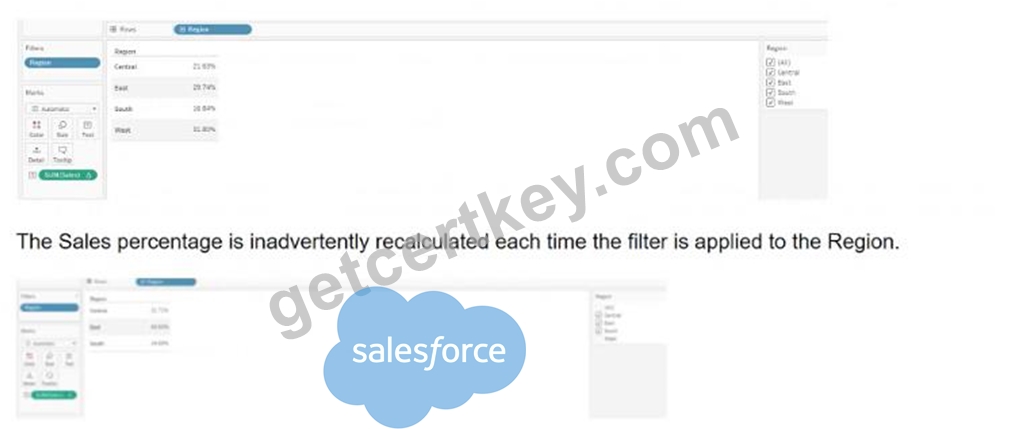
Which calculation will fix the automatic recalculation on the % of total field?
- A. {FIXED [Region]:[Sales]}/{FIXED: SUM([Sales])}
- B. {FIXED [Region]:sum([Sales])}/{FIXED :SUM([Sales])
- C. {FIXED [Region]:sum([Sales])}/SUM([Sales]}
- D. {FIXED [Region]:sum([Sales])}
Answer: C
Explanation:
To correctly calculate the percent of total sales for a particular region compared to all regions, and to ensure that the calculation does not get inadvertently recalculated with each region filter application, the recommended calculation is:
{FIXED [Region]: sum([Sales])}: This part of the formula computes the sum of sales for each region, regardless of any filters applied to the view. It uses a Level of Detail expression to fix the sum of sales to each region, ensuring that filtering by regions won't affect the calculated value.
SUM([Sales]): This part computes the total sum of sales across all regions and is recalculated dynamically based on the filters applied to other parts of the dashboard or worksheet.
Combining the two parts: By dividing the fixed regional sales by the total sales, we get the proportion of sales for each region as compared to the total. This calculation ensures that while the denominator adjusts according to filters, the numerator remains fixed for each region, accurately reflecting the sales percentage without being affected by the region filter directly.
References
This calculation follows Tableau's best practices for using Level of Detail expressions to manage computation granularity in the presence of dashboard filters, as outlined in the Tableau User Guide and official Tableau training materials.
NEW QUESTION # 80
A consultant is working with a Tableau Server customer. The customer asks the consultant if there is a need to upgrade their instance of Tableau Server that was installed over 1 year ago.
Which two situations justify the need for an upgrade? Choose two.
- A. Compatibility with newer Tableau Desktop and Prep Builder versions that users might want to install
- B. The security team has a report of bugs and security vulnerabilities in older versions of Tableau
- C. Users are complaining of performance; the upgrade will reduce the server's hardware requirements
- D. The need to access new features and improvements from Tableau Cloud
Answer: A,B
Explanation:
Comprehensive and Detailed Explanation From Exact Extract:
Tableau's upgrade guidance identifies two major drivers for upgrading Tableau Server:
* Version Compatibility with Tableau Desktop and Tableau Prep Builder
* Tableau Server must be equal to or newer than the version used by Desktop and Prep Builder for publishing.
* Organizations upgrading Desktop often must upgrade Server to avoid compatibility issues.
* This is a core reason to update a year-old installation.
* Security and Bug Fixes
* Tableau regularly publishes security patches, bug fixes, and stability enhancements.
* Older versions accumulate unresolved security issues that may be identified by security teams.
* Tableau explicitly states that upgrading ensures the instance receives the latest security protections.
Option B is incorrect because upgrading does not reduce hardware requirements; in many cases hardware needs may increase.
Option C is incorrect because Tableau Cloud features do not require upgrading Tableau Server. Tableau Cloud enhancements are independent of Server versions.
Therefore, the two conditions that justify upgrading are maintaining compatibility and addressing security vulnerabilities.
* Tableau's version compatibility matrix requiring alignment between Tableau Server and Desktop/Prep.
* Upgrade planning documents emphasizing security patches and bug fixes as key upgrade drivers.
* Notes describing that performance complaints alone are not solved simply by upgrading.
NEW QUESTION # 81
A consultant migrated a data source to improve performance. The consultant wants to identify which workbooks need to be updated to point to the new data source.
Which Tableau tool should the consultant use?
- A. Prep Conductor
- B. Tableau Advanced Management
- C. Data Management
- D. Activity Log
Answer: B
Explanation:
To identify which workbooks need to be updated to point to a new data source after a migration, a consultant should use Tableau Advanced Management. This component of Tableau provides comprehensive management capabilities including the ability to track workbook dependencies and data source usage across your entire Tableau environment. Using Tableau Advanced Management allows consultants to assess the impact of changes in the data source on connected workbooks and efficiently manage updates.
NEW QUESTION # 82
A client wants to see data for only the most recent day in the dataset that is updated intermittently. The solution should offer the best caching performance.
Which approach should the consultant use to produce the desired results?
- A. Fixed Level of Detail (LOD) date calculation
- B. Relative date filters
- C. TODAY function
- D. Quick filter
Answer: A
Explanation:
Comprehensive and Detailed Explanation From Exact Extract:
The client wants to always show the most recent day present in the data, not today's date. The dataset is updated intermittently, meaning some days may have no new rows. Tableau documentation states that:
* Using TODAY() recalculates on every query and prevents effective caching because Tableau must compute the current date for each refresh.
* Using Relative Date Filters like "Last 1 day" also prevents caching because Tableau evaluates relative conditions each time the workbook loads.
* Quick Filters also break caching and decrease performance because they require interactive evaluation on each render.
* A FIXED LOD calculation allows Tableau to compute the maximum date inside the extract, which preserves caching because it is data-driven, not time-driven.For example:{ FIXED : MAX([Date]) } Then filtering where [Date] = { FIXED : MAX([Date]) } ensures only the most recent date in the dataset is shown.
Tableau's documentation on performance emphasizes that caching is maximized when calculations depend only on the data itself and not on functions like TODAY() or relative filters.
A FIXED LOD provides the best caching performance and correctly returns the most recent date based on the dataset rather than the current system date.
* Tableau extract caching behavior describing how data-dependent filters cache better than time- dependent filters.
* LOD Expressions guidance recommending FIXED for identifying values like "latest date in the dataset."
* Tableau performance guidelines discouraging TODAY() and relative date filters when caching is important.
NEW QUESTION # 83
A company's Tableau Cloud admin wants to maintain control over what content gets published to its site for viewers, while also supporting self-service for dashboard creators.
Which governance strategy should the admin implement?
- A. Create sandbox projects to contain ad hoc content and production projects for validated content.
- B. Maintain a separate sandbox site and use the Content Migration Tool to promote content between sites.
- C. Allow dashboard creators to publish to their Personal Space and for site administrators to move content to projects.
- D. Restrict users' permission to view data sources used in uncertified dashboards.
Answer: A
Explanation:
Comprehensive and Detailed Explanation From Exact Extract:
Tableau's recommended content governance model for Server and Cloud emphasizes project-based separation between development ("sandbox") content and certified, production-ready content.
Key points from Tableau governance guidance:
* Organizations should define sandbox projects where creators can freely publish and iterate on workbooks and data sources.
* Once content is reviewed and validated, it is promoted into "production" projects that are designated for trusted content for viewers.
* This model allows self-service authoring while keeping tight control over what is exposed to broad viewer audiences.
Option A exactly reflects this model: sandbox projects for ad hoc content, and production projects for validated content.
Option B uses separate sites and the Content Migration Tool, which is heavier to manage and usually reserved for cross-environment moves (such as dev to prod), not necessary for basic project-level governance in a single Tableau Cloud site.
Option C relies on Personal Space. Tableau recommends Personal Space for private drafts, not as the main promotion path, and it is not the primary governance pattern for viewer-facing content.
Option D restricts data source viewing but does not provide a full governance strategy for managing ad hoc versus production dashboards.
Therefore, the correct strategy is sandbox projects plus production projects, which is option A.
* Tableau governance whitepapers describing sandbox versus production projects as a best-practice pattern.
* Tableau Cloud site administration guidance recommending project structure for self-service and controlled promotion of content.
NEW QUESTION # 84
......
We will give you full refund if you fail to pass the exam after buying Analytics-Con-301 exam torrent from us. We are pass guarantee and money back guarantee if you fail to pass the exam. And money will be returned to your payment account. In addition, Analytics-Con-301 exam dumps are high- quality, and you can pass your exam just one time if you choose us. We offer you free update for 365 days for Analytics-Con-301 Exam Dumps, and the latest version will be sent to your email automatically. We have online service, if you have any questions, you can have a chat with us.
New Analytics-Con-301 Exam Dumps: https://www.getcertkey.com/Analytics-Con-301_braindumps.html
- Salesforce Analytics-Con-301 Exam | Analytics-Con-301 Exam Actual Tests - Instant Download of New Analytics-Con-301 Exam Dumps ⬅️ Immediately open ➡ www.exam4labs.com ️⬅️ and search for ▷ Analytics-Con-301 ◁ to obtain a free download ????Test Analytics-Con-301 Assessment
- Pass Guaranteed Quiz Perfect Analytics-Con-301 - Salesforce Certified Tableau Consultant Exam Actual Tests ???? Open ➽ www.pdfvce.com ???? enter “ Analytics-Con-301 ” and obtain a free download ????Analytics-Con-301 Hot Spot Questions
- 100% Pass Quiz 2026 Salesforce Authoritative Analytics-Con-301: Salesforce Certified Tableau Consultant Exam Actual Tests ???? Open { www.torrentvce.com } and search for ☀ Analytics-Con-301 ️☀️ to download exam materials for free ????Analytics-Con-301 Hot Spot Questions
- Online Analytics-Con-301 Bootcamps ???? Exam Dumps Analytics-Con-301 Pdf ???? Online Analytics-Con-301 Bootcamps ???? Search for ➽ Analytics-Con-301 ???? and easily obtain a free download on ✔ www.pdfvce.com ️✔️ ⚗Analytics-Con-301 Valid Study Plan
- Analytics-Con-301 Exam Dumps Provider ???? Test Analytics-Con-301 Guide Online ???? Analytics-Con-301 Reliable Study Questions ???? Easily obtain free download of ➤ Analytics-Con-301 ⮘ by searching on ▶ www.prepawaypdf.com ◀ ????Analytics-Con-301 Discount
- Prepare for Analytics-Con-301 with Salesforce's Realistic Exam Questions and Get Accurate Answers ???? The page for free download of ▷ Analytics-Con-301 ◁ on [ www.pdfvce.com ] will open immediately ????Test Analytics-Con-301 Guide Online
- 100% Pass Quiz 2026 Salesforce Authoritative Analytics-Con-301: Salesforce Certified Tableau Consultant Exam Actual Tests ???? Easily obtain ▶ Analytics-Con-301 ◀ for free download through ⇛ www.troytecdumps.com ⇚ ????Analytics-Con-301 Exam Sample Online
- Salesforce Analytics-Con-301 Exam | Analytics-Con-301 Exam Actual Tests - Instant Download of New Analytics-Con-301 Exam Dumps ???? Easily obtain free download of ➥ Analytics-Con-301 ???? by searching on ➠ www.pdfvce.com ???? ????Analytics-Con-301 Latest Test Experience
- Salesforce Analytics-Con-301 Exam | Analytics-Con-301 Exam Actual Tests - Instant Download of New Analytics-Con-301 Exam Dumps ???? Search for ➥ Analytics-Con-301 ???? on [ www.pdfdumps.com ] immediately to obtain a free download ????Analytics-Con-301 Latest Test Experience
- Reliable Analytics-Con-301 Exam Book ???? Analytics-Con-301 Valid Exam Testking ???? Analytics-Con-301 Valid Exam Testking ???? Download { Analytics-Con-301 } for free by simply entering ⇛ www.pdfvce.com ⇚ website ????Analytics-Con-301 Discount
- Preparation Material with Free Demos and Updates [2026] ???? Search on ⇛ www.validtorrent.com ⇚ for ➡ Analytics-Con-301 ️⬅️ to obtain exam materials for free download ????Analytics-Con-301 Exam Dumps Provider
- cyrusrxhi209253.blognody.com, isaiahqexm426391.anchor-blog.com, tinybookmarks.com, isaiahxpkn781837.webdesign96.com, www.stes.tyc.edu.tw, livebackpage.com, ianznvm146068.bleepblogs.com, zaynabtkgz989693.ktwiki.com, phoenixgxsy379775.activoblog.com, katrinasbib953598.tdlwiki.com, Disposable vapes
P.S. Free 2026 Salesforce Analytics-Con-301 dumps are available on Google Drive shared by Getcertkey: https://drive.google.com/open?id=1IzdTqI--n5dw1tRXEKypXZcZ3OaS7GTs
Report this wiki page